 Request a quote
Commissioning L1 to L5, proven against the standards your project uses
Every product we supply is factory tested at L1. Site levels L2 to L5 are available on request, for our products and for the systems around them, in the UK, Europe and the UAE.
Presented by our founder, a real person. Video produced with AI. Full transcript alongside.
Commissioning L1 to L5
Every product we supply is tested at the factory before it ships. That is level one, and you always get it.
If you want more, we commission on site. Level two: delivery inspection. Level three: pre-commissioning and start up.
Level four: functional testing of each system. Level five: integrated systems testing. Tags follow your colour scheme, and every record goes into your digital system.
Tell us which levels you need.
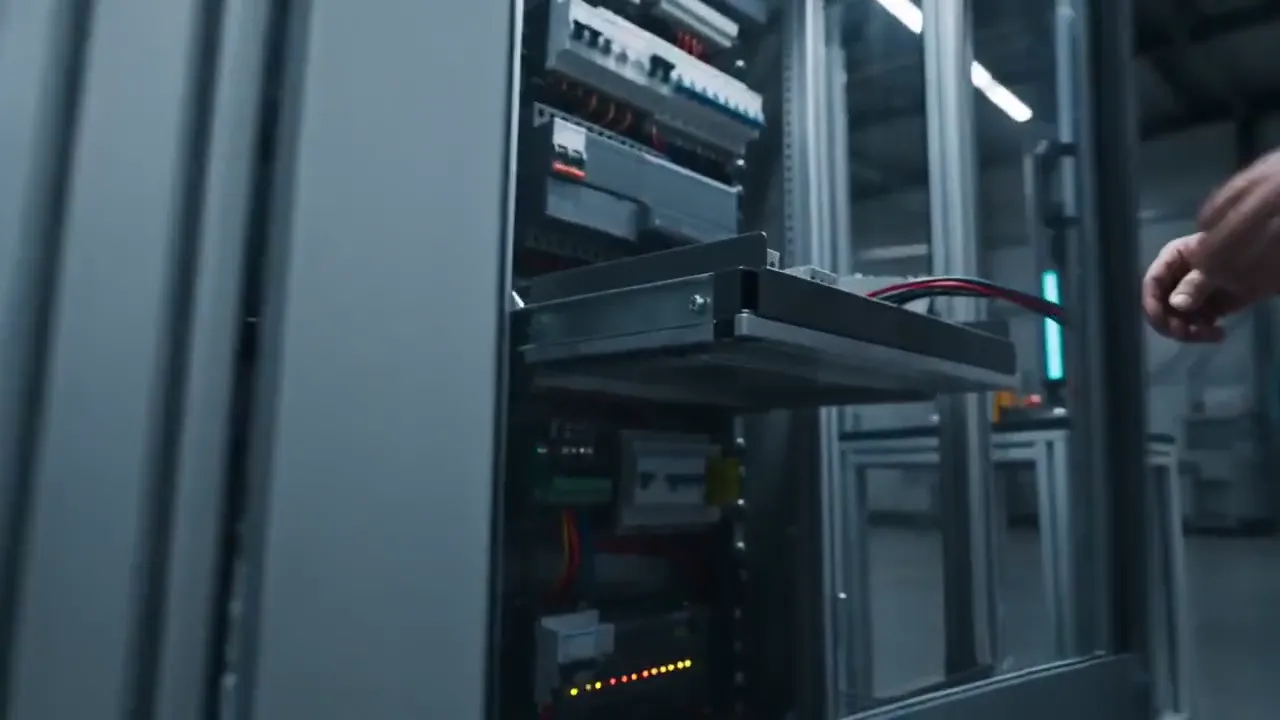
Product animation for illustration.
Tested before it ships.
Every product is tested at the factory against an agreed script. You can witness the test, and the report travels with the equipment.
- Test script agreed before the test
- Witnessed in person or remotely
- Report delivered before dispatch
- Level 1 tag in your colour scheme
From factory to fully integrated.
Commissioning levels are an established convention in the data centre sector rather than a single published standard, and definitions differ between operators. These are the definitions we work to. Where you have your own matrix, we adopt it.
Factory acceptance
The equipment meets its specification before it leaves the factory.
- Witnessed factory acceptance test to an agreed script
- Routine verification of assemblies to IEC 61439 for panels and switchboards
- Hydrostatic and leak tests on manifolds and pipework modules, chart recorded
- Function tests of controls, interlocks and protection settings
- FAT report signed by the witnesses
- Routine test certificates and declaration of conformity
- Punch list closed before shipment
Delivery and installation verification
What arrived is what was approved, undamaged, stored and installed correctly.
- Inspection on arrival against the approved submittals
- Storage and protection checks until installation
- Installation checked against the drawings, with restraint and torque records where required
- A unique QR identity on every asset, bound to its serial number and position
- Conformity recorded per unit in the asset register, not per consignment
Start up and pre-functional
Each system is safe and ready to energise or to fill.
- Electrical dead tests before energisation: continuity, insulation resistance, polarity, phase rotation and protective device settings (BS 7671 Part 6, IEC 60364-6)
- Liquid systems: pressure test at 1.3 to 1.5 times operating pressure and a nitrogen dwell test
- Sectional flushing with the CDUs isolated, chemical clean and passivation, staged filtration
- Fill and laboratory acceptance of the fluid quality (BSRIA pre-commission cleaning and water treatment guidance)
- Test sheets per circuit and per loop section
- Laboratory fluid certificates
Functional performance testing
Each system works on its own in every mode and every fault it is designed for.
- Load banks and rack heat load emulators at 25, 50, 75 and 100 per cent of duty
- Every operating mode, alarm and failover tested, including backup and bypass paths
- BMS and power monitoring points verified end to end
- Thermographic survey under load
- Signed functional test scripts with measured results against the design figures
Integrated systems testing
All systems work together under real failure scenarios.
- Loss of utility, generator start and transfer, UPS transfer and retransfer
- Loss of cooling and recovery
- Fire alarm cause and effect across all connected systems
- Run to your script or your commissioning authority's script: we provide the load, the instrumentation and the attendance
- Integrated systems test report with time stamped events and trend data
Proven with instruments, not signatures.
What the tests behind each level look like. Every result is measured, recorded against its acceptance criterion and kept in your records. The animations below are illustrations.
Load banks at 25, 50, 75 and 100 per cent
Load banks and rack heat load emulators stand in for IT that is not yet installed, so power and cooling are proven at every step of duty.
Dead tests before a board is energised
Continuity, insulation resistance, polarity and phase rotation on every DB and RPP, with each result recorded per circuit.
Pressure held, then proven
Liquid systems are tested at 1.3 to 1.5 times operating pressure and held, then checked again with a nitrogen dwell test.
Flushed until the numbers say clean
Sectional flushing with the CDUs isolated and staged filtration, until particulate levels meet the target and the fluid passes laboratory tests.
Thermographic survey under load
Boards and connections are scanned with a thermal camera while under load, so a loose or overheating joint is found before it fails.
Failure scenarios, run for real
Loss of utility, generator start and transfer, UPS transfer and retransfer, each event time stamped in the integrated systems test report.
Commissioning comes last, when there is no float left. Book it at design stage.
Every UK firm in a 2026 industry survey reported shortages of qualified mechanical, electrical and plumbing workers, and more than 70% of markets said contractor capacity for data centre projects is tightening or overstretched. Engineers who can take a site from L1 to L5 are booked early. Bring us in with the design: we plan the levels, the test scripts and the witness points with your team, and every product we supply is tested in the factory before it reaches site.
Source: Turner and Townsend, Global Construction Market Intelligence 2026 (August 2026).
Learn more about commissioning.
Commissioning L1 to L5: what each level proves
From factory acceptance to integrated systems testing, and who signs off what.
Load bank testing: what it proves
Generators, UPS systems and cooling proven at full duty before the IT arrives.
Integrated systems testing: what happens on the day
The scenarios, the evidence and what a pass looks like.
Commissioning L1 to L5 checklist
What each level should cover and the evidence to keep. Enter your email and download it straight away, with our sample FAT report and inspection and test plan.
Built on recognised practice in every market we serve.
Each activity in our inspection and test plan names the standard or guidance it is drawn from. The list below is the framework; the project specification and local regulations always take precedence.
- CIBSE Commissioning Code M (2022) and the CIBSE codes for air, water, controls, lighting and refrigeration
- BSRIA guidance: model commissioning plan, water and air systems, pre-commission cleaning, closed system water treatment
- BS 7671 Part 6 inspection and testing
- BS 8536 and Soft Landings for briefing, handover and aftercare
- Building Regulations commissioning, and the golden thread for higher-risk buildings under the Building Safety Act
- BS 5839-1 fire detection, BS 5266-1 emergency lighting, BS 7346-8 smoke control
- EN 50600 and ISO/IEC 22237 for data centre facilities
- IEC 61439 routine verification of low voltage assemblies
- IEC 60364-6 initial verification, applied through national rules such as REBT in Spain and DIN VDE 0100-600 in Germany
- VDI 6039 commissioning management in Germany, RITE for thermal installations in Spain
- Pressure Equipment Directive where its thresholds apply
- Dubai Al Sa'fat: commissioning of building services in new buildings (503.01), re-commissioning of existing buildings (503.02), performance and commissioning reports (503.07)
- UAE Fire and Life Safety Code of Practice and Civil Defence approvals
- ASHRAE standards, widely specified on UAE projects
- ASHRAE Standard 202-2024 and Guideline 0-2019, the commissioning process
- ASHRAE Standard 230-2022 for existing buildings, Guideline 1.1 for HVAC and Guideline 1.5 for smoke control
- ANSI/NETA ATS-2025 acceptance testing of electrical power equipment
- NFPA 4 integrated fire protection and life safety system testing
Nothing left without an owner.
- A commissioning plan and an inspection and test plan agreed before work starts
- Every test carries its acceptance criterion, the standard it comes from and the evidence we issue
- Your commissioning matrix adopted where you have one
- Advance witness notices, so you or your commissioning authority can attend
- An interface responsibility matrix: every test that needs two parties has a named owner and a date
- Dependencies such as primary water, heat rejection and power programmed as dated milestones before we mobilise
- Commissioning tags applied to your colour scheme
- Records entered in your digital commissioning system, if you use one
Thousands of results, one click away.
On a large fit-out a single level can mean more than ten thousand individual test results. We record them digitally from day one, so the evidence pack builds as the work progresses.
How the register works
- A QR identity on every asset, linked to its serial number and exact position
- Results recorded by scanning, with the operative, date, instrument and calibration
- Records exported to your common data environment as the work progresses
- Each level closed by a filtered export showing every asset in scope with a pass
- Partial handover by zone, and the full test history of any asset on demand
What goes wrong elsewhere, designed out here.
Interfaces fail first
Failures often happen where two suppliers meet, so every interface test has a named owner.
Components before integration
Each component is proven before integrated testing, so problems do not stack up at L5.
Backup paths are tested
Bypass and standby paths are operated, not assumed, so they work on the day they are needed.
Time for performance tests is protected
Functional and integrated tests are not cut when the programme is squeezed.
Scripts fit the site
Test scripts are written for your design and redundancy, not copied from a generic checklist.
Procedures are followed
Of major outages caused by human error, 85 per cent stem from staff not following procedures or from flawed procedures (Uptime Institute, 2025). Our tests run to written, witnessed scripts.
Detection tested at design airflow
Fire and gas detection is proven with the room air running, because static tests do not show installed performance.
Heat exchangers protected
Liquid loops are flushed with the CDUs isolated, so debris never reaches the heat exchangers and warranties are kept.
Everything you need to operate and maintain.
- Commissioning records for every level in scope
- Test reports from factory and site
- Operation and maintenance information and as installed records
- Digital product data for your digital twin
- Training for your operations team
- Fine tuning and seasonal testing if your contract includes it
You still get L1.
Every product is factory tested and arrives with its FAT report and certificates. You choose whether we also commission on site, and at which levels.
See our productsQuestions buyers ask
What are commissioning levels L1 to L5?
L1 factory acceptance, L2 delivery inspection, L3 pre-commissioning and start up, L4 functional testing of each system, L5 integrated systems testing.
Do we get L1 if we only buy products?
Yes. Every product is factory tested and arrives with its test report.
Who signs off each level?
The commissioning manager or authority on your project. We provide scripts, records and witnesses for the levels in our scope.
How long does commissioning take?
It depends on the size of the project. On large data centres, L1 to L5 often runs for several months, and integrated testing alone can take weeks. We give you a programme with each quote.
Can you use our colour tags and our digital system?
Yes. Tags follow your scheme and records go into your system.
Tell us your systems, levels and dates.
We contact you within one working day, the same day on WhatsApp. You receive a commissioning scope, the standards we propose and a programme within 48 hours of receiving the information we need.